07/28/2026
The Financial Impact of Heatwaves on Agriculture & Livestock in Europe
A comparative assessment across France, Spain, Germany, Poland and Ukraine (2027–2031)
White Paper
Produced by ATLARIS
Executive Summary
Heatwaves are becoming an increasingly material physical climate risk affecting European agriculture. Beyond their direct consequences on crop yields and livestock productivity, prolonged heat events can affect agricultural profitability through lower economic activity, higher expenses, and growing adaptation requirements.
This white paper presents a comparative financial assessment of heatwave impacts on NACE A01 – Crop and Animal Production, Hunting and Related Service Activities across five major European agricultural economies: France, Spain, Germany, Poland, and Ukraine.
Using ATLARIS' environmental financial modelling methodology, the analysis estimates how projected heatwave intensity and frequency may affect economic activity and expenses between 2027 and 2031. Rather than relying on qualitative climate indicators or ESG scores, the assessment translates physical climate hazards into financial variables that can be used by investors, lenders, insurers, and corporate decision-makers.
The updated results show material differences between countries. Ukraine and Spain exhibit the largest economic activity impacts, while Germany records the lowest impact among the five countries analysed. Expense impacts are highest in Ukraine, followed by Spain and Poland.
Under the selected severe-but-plausible scenario, the average economic activity impact over 2027–2031 is estimated at:
Ukraine: -5.43%
Spain: -5.04%
Poland: -2.50%
France: -2.18%
Germany: -1.09%
The corresponding average expense impacts are:
Ukraine: +3.40%
Spain: +1.51%
Poland: +1.56%
France: +1.25%
Germany: +0.62%
These results illustrate how heatwaves can generate a dual financial effect: reducing economic activity while simultaneously increasing the expenses required to maintain agricultural operations.
1/ Introduction
Heatwaves are no longer exceptional climatic events. Across Europe, rising temperatures, longer heatwave periods, and more frequent temperature extremes are increasing the potential for disruption to agricultural production.
For crop production, excessive temperatures can reduce photosynthesis, accelerate evapotranspiration, shorten grain-filling periods, and ultimately reduce yields and product quality. Livestock systems are similarly affected through heat stress, resulting in lower milk production, reduced weight gain, fertility issues, and increased mortality during prolonged extreme events.
These physical impacts can rapidly translate into financial consequences.
Reduced production volumes and productivity can affect economic activity, while additional irrigation, cooling systems, veterinary care, crop protection measures, and water management can increase expenses.
Understanding these financial consequences is therefore increasingly relevant for banks, investors, insurers, agribusinesses, and public institutions.
2/ Methodology
The assessment was performed using the ATLARIS environmental financial modelling framework.
Sector
NACE A01 : Crop and Animal Production, Hunting and Related Service Activities.
Countries: France, Spain, Germany, Poland and Ukraine.
Only physical climate risks associated with heatwaves were considered.
Economic Activity impacts
Economic activity impacts were estimated from the following hazards:
Heat stress reducing crop productivity and quality
Heatwave days and temperature anomalies
Heatwaves causing crop stress, lower milk yield, lower livestock weight gain, and livestock mortality
Heat damage during flowering and grain filling reducing agricultural output
Expense impacts
Expense impacts were estimated using:
Heatwave days and temperature anomalies
Heat stress increasing cooling, shading, and crop protection expenses
Heatwaves increasing cooling, water management, and livestock management expenses
The results presented correspond to ATLARIS financial impact estimates under a severe but plausible climate scenario for the period 2027–2031.
The percentages represent the estimated impact on the NACE A01 economic activity and expenses relative to the relevant baseline. The annual figures should therefore be interpreted as the estimated impact associated with heatwave conditions in each year, rather than as cumulative losses across the full period.
3/ Results
Economic Activity impacts
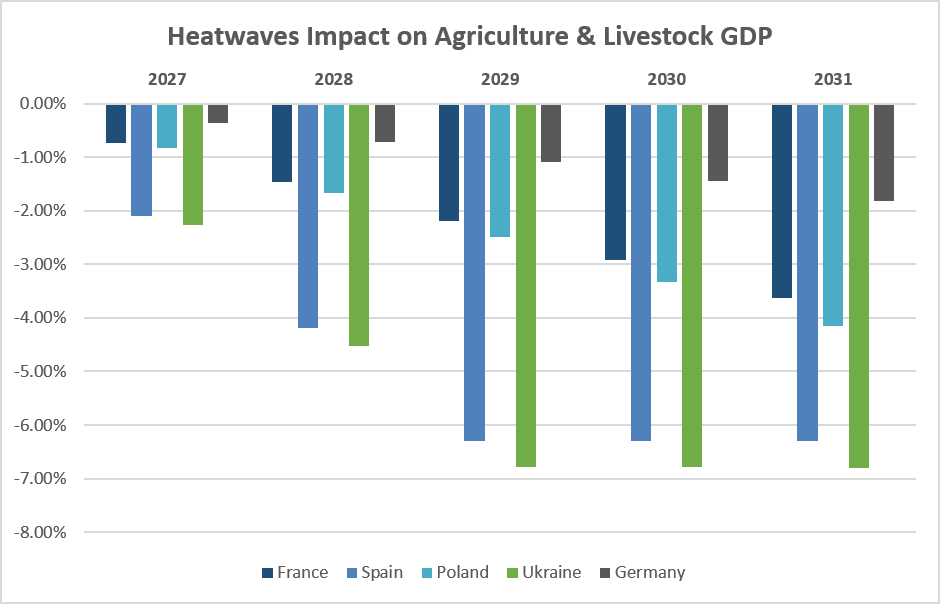
The updated results indicate a progressive deterioration in agricultural economic activity across all five countries during the assessment period, although the magnitude and trajectory differ significantly.
Spain
Spain records a substantial impact from the beginning of the assessment period. The estimated impact increases from -2.10% in 2027 to -6.30% in 2029, remaining at approximately -6.30% through 2031.
The five-year average impact is estimated at -5.04%.
This profile reflects the significant sensitivity of agricultural activity to prolonged heat conditions, including potential impacts on crop productivity, water availability, and livestock performance.
Ukraine
Ukraine shows the largest average economic activity impact among the countries analysed. The estimated impact increases from -2.26% in 2027 to -6.78% in 2029, reaching approximately -6.79% in 2030 and 2031.
The five-year average impact is estimated at -5.43%.
The results indicate significant sensitivity of agricultural activity to heatwave conditions under the selected scenario.
Poland
Poland exhibits a more progressive deterioration throughout the period. The estimated impact increases from -0.83% in 2027 to -4.16% by 2031.
The five-year average impact is estimated at -2.50%.
This trajectory illustrates how the financial effects of heatwave conditions can increase progressively over the assessment horizon.
France
France experiences a gradual but persistent deterioration in economic activity. The estimated impact increases from -0.73% in 2027 to -3.63% in 2031.
The five-year average impact is estimated at -2.18%.
The results indicate a progressively increasing financial effect on agricultural activity as heatwave conditions intensify under the selected scenario.
Germany
Germany records the lowest estimated economic activity impact among the five countries analysed. The impact increases from -0.37% in 2027 to -1.82% by 2031.
The five-year average impact is estimated at -1.09%.
Nevertheless, the results indicate that heatwave conditions can still generate a measurable financial effect even where the estimated impact is comparatively lower.
Overall observations
Across the five countries, the model estimates an average economic activity impact of approximately -3.25% over 2027–2031.
The results therefore indicate that heatwaves can generate material financial effects across European agriculture, with the magnitude varying according to country-specific exposure, sector characteristics, and the assumptions incorporated into the model.
Expense impacts
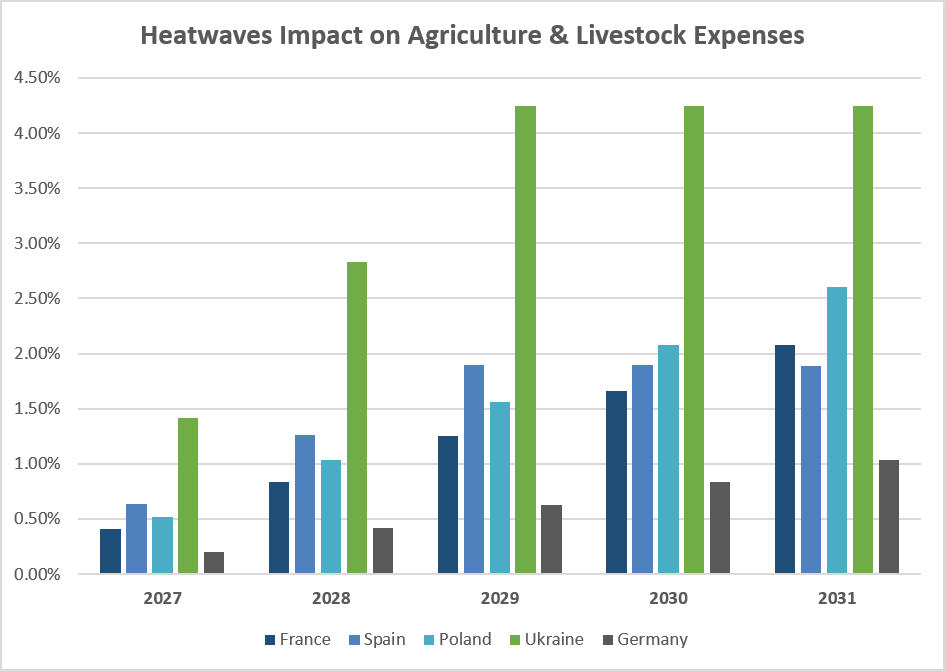
Heatwaves also generate increases in expenses as agricultural producers respond to deteriorating climatic conditions.
The updated model indicates that expense impacts remain positive across all five countries throughout the assessment period.
Ukraine
Ukraine records the highest expense impact. Expenses increase from +1.41% in 2027 to approximately +4.25% from 2029 onward.
The five-year average expense impact is estimated at +3.40%.
This indicates a significant increase in the resources required to maintain agricultural operations under the selected heatwave scenario.
Poland
Poland records an expense impact increasing progressively from +0.52% in 2027 to +2.60% in 2031.
The five-year average impact is estimated at +1.56%.
Spain
Spain's expenses increase from +0.63% in 2027 to approximately +1.89% from 2029 onward.
The five-year average expense impact is estimated at +1.51%.
The results indicate that maintaining agricultural production under persistent heat stress requires additional resources despite the relatively stable expense impact after 2029.
France
France experiences a gradual increase in expenses, from +0.41% in 2027 to +2.07% in 2031.
The five-year average expense impact is estimated at +1.25%.
Germany
Germany records the lowest expense impact among the countries analysed. Expenses increase from +0.20% in 2027 to +1.04% in 2031.
The five-year average expense impact is estimated at +0.62%.
Overall observations
Across the five countries, the model estimates an average expense impact of approximately +1.67% over 2027–2031.
Unlike economic activity impacts, which represent a reduction, expense impacts represent additional costs associated with responding to heatwave conditions.
4/ Financial implications
The updated analysis highlights an important financial transmission mechanism.
Heatwaves do not necessarily affect only one financial variable.
Instead, they can simultaneously reduce economic activity and increase expenses.
This combination can create pressure on agricultural operating margins and cash generation. A reduction in production and economic activity can occur at the same time as producers incur additional expenses for irrigation, cooling, livestock management, crop protection, water management, and other adaptation measures.
The magnitude of this effect varies significantly by country.
For example, under the selected scenario, Ukraine records an average -5.43% economic activity impact alongside a +3.40% expense impact, while Germany records a -1.09% economic activity impact alongside a +0.62% expense impact.
These figures should not be interpreted as direct estimates of profitability or enterprise-value reduction. Rather, they represent modelled impacts on economic activity and expenses that can subsequently be incorporated into broader financial analysis.
For lenders, investors, insurers, and agribusinesses, understanding these transmission mechanisms can support analysis of:
Revenue and activity sensitivity
Expense and margin pressure
Cash-flow resilience
Investment requirements
Adaptation needs
Asset and portfolio exposure
Long-term financial resilience
Traditional climate indicators describe environmental exposure.
Financial analysis requires understanding how those hazards ultimately affect economic activity, expenses, capital expenditure, cash flows, and valuation.
5/ Conclusion
Heatwaves represent an increasingly relevant financial risk for European agriculture.
The comparative assessment presented in this paper demonstrates that the same physical climate hazard can generate materially different financial impacts depending on country, agricultural conditions, and sector characteristics.
Under the selected severe-but-plausible scenario, the model estimates an average -3.25% impact on economic activity and a +1.67% impact on expenses across the five countries over 2027–2031.
The results also demonstrate the importance of considering both sides of the financial transmission mechanism. Agricultural businesses may experience declining economic activity while simultaneously facing increasing expenses to maintain production and respond to heat stress.
By translating physical climate risks into financial variables, ATLARIS enables financial institutions, investors, and corporates to move beyond qualitative climate assessments and incorporate environmental risks into financial analysis and strategic planning.
As climate-related hazards evolve, understanding their financial transmission mechanisms can support more informed assessment of agricultural resilience, adaptation requirements, and investment risk.
Related Research Areas
Climate Risk Assessment
Environmental Financial Risk
Physical Climate Risk
Agricultural Economics
Biodiversity Risk
Transition Risk
Financial Scenario Analysis
Climate Adaptation
Investment Risk
Environmental Risk Modelling