09/22/2026
The Financial Impact of Heatwaves on Real Estate in Europe

A comparative assessment across France, Spain, Germany, Poland and Ukraine (2027–2031)
White Paper
Produced by ATLARIS
Executive Summary
Heatwaves are becoming an increasingly material physical climate risk for the European real estate sector. Beyond their direct consequences on buildings and occupants, extreme heat can disrupt construction activity, reduce labour productivity, and increase the cost of maintaining safe and operational working conditions.
This white paper presents a comparative financial assessment of heatwave impacts on the Real Estate sector across five European economies: France, Spain, Germany, Poland, and Ukraine.
Using ATLARIS' environmental financial modelling methodology, the analysis estimates how heatwave conditions may affect real estate economic activity and operating expenses between 2027 and 2031. Rather than relying on qualitative climate indicators or ESG scores, the assessment translates physical climate hazards into financial variables directly relevant to investors, lenders, developers, asset managers, insurers, and corporate decision-makers.
The results reveal differences between countries, reflecting variations in heat exposure, construction activity, labour conditions, and the sector's vulnerability to extreme temperatures.
Ukraine records the highest average estimated impact on real estate economic activity, at approximately -0.51%, followed by Spain at -0.50%. France and Poland record average impacts of approximately -0.31% and -0.32%, respectively, while Germany records the lowest average impact at approximately -0.16%.
Operating expenses increase across all five countries. Ukraine records the highest average estimated increase at approximately 1.27%, followed by Spain at 1.01%, Poland at 0.93%, France at 0.78%, and Germany at 0.38%.
Across the five countries, the average estimated impact on real estate economic activity is approximately -0.36%, while operating expenses increase by approximately 0.87%.
1/ Introduction
Heatwaves are becoming an increasingly important physical climate risk for the real estate sector. Rising temperatures and extreme heat can create operational challenges for construction activities and the management of real estate assets.
Real estate is particularly exposed because the sector depends heavily on physical assets, construction activities, outdoor labour, and complex project schedules. During periods of extreme heat, construction workers may experience reduced productivity as working conditions become increasingly difficult and additional safety measures may be required.
These physical impacts can translate into financial consequences.
Heat stress can reduce labour productivity and affect construction activity. Lower productivity can reduce the amount of work completed under normal operating conditions and potentially affect construction timelines and project execution.
At the same time, heatwaves can increase operating expenses. Buildings and facilities may require additional cooling, while developers, construction companies and other real estate operators may need to implement additional worker-safety measures and absorb higher labour costs associated with extreme heat.
Understanding these financial consequences is therefore increasingly important for real estate investors, developers, lenders, insurers, asset managers, and property owners.
2/ Methodology
The assessment was performed using the ATLARIS environmental financial modelling framework.
The analysis focuses on:
Sector: Real Estate
Countries: France, Spain, Germany, Poland and Ukraine
Only physical climate risks associated with heatwaves were considered.
Impact on Real Estate Economic Activity
The impact on real estate economic activity was estimated based on the following transmission mechanisms:
Heatwaves reducing labour productivity
Heatwaves slowing construction timelines
Extreme temperatures reducing the efficiency of construction activities
Heat-related disruption affecting project execution and overall real estate sector activity
Operating Expense Impacts
Operating expense impacts were estimated using:
Heatwaves increasing cooling requirements
Heatwaves requiring additional worker-safety measures
Heatwaves increasing labour costs
Additional operational requirements associated with maintaining safe and functional working conditions under extreme heat
3/ Interpretation of Results
The results presented correspond to ATLARIS estimated financial impacts under a severe but plausible heatwave stress scenario for the period 2027–2031.
The estimated impacts represent the financial effect of heatwave conditions on real estate economic activity and operating expenses under the assessed scenario.
Economic activity impacts represent the estimated deterioration in real estate activity associated with heatwave conditions, primarily through reduced labour productivity and construction activity.
Similarly, operating expense impacts represent the estimated incremental costs associated with heatwave conditions, including additional cooling, safety measures and labour costs.
For example, an estimated -0.63% impact on real estate economic activity means that real estate activity is estimated to be approximately 0.63% lower under the assessed heatwave conditions relative to the expected level of activity in the absence of the assessed conditions.
Likewise, an estimated +1.26% operating expense impact means that operating expenses are estimated to be approximately 1.26% higher under the assessed heatwave conditions.
The country averages presented in this paper represent the average estimated impact across the five-year assessment period.
4/ Results
Impact on Real Estate Economic Activity
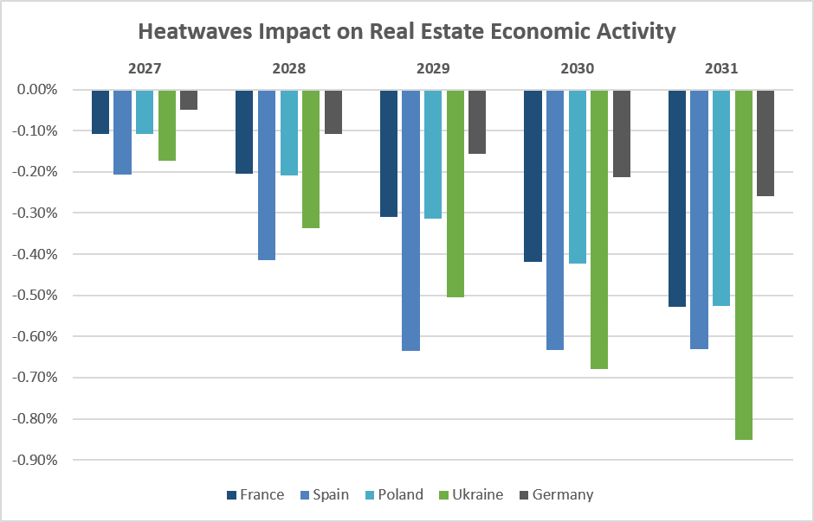
The percentages presented below represent the estimated impact of heatwave conditions on real estate economic activity. The figures capture the estimated financial effect relative to the expected level of activity in the absence of the assessed heatwave conditions.
Ukraine records the highest average estimated impact on real estate economic activity among the countries analysed. The impact increases progressively from -0.17% in 2027 to -0.85% in 2031, resulting in an average impact of approximately -0.51% over the assessment period. The results reflect the increasing sensitivity of real estate activity to heat-related reductions in labour productivity and disruptions to construction activity.
Spain also exhibits a significant estimated impact, increasing from -0.21% in 2027 to -0.64% in 2029, before stabilising at approximately -0.63% through 2031. The average estimated impact reaches approximately -0.50%. The results indicate that extreme heat can materially affect real estate activity through reduced labour productivity and constraints on construction execution.
Poland experiences a gradual deterioration in real estate economic activity, with the estimated impact increasing from -0.11% in 2027 to -0.53% in 2031, resulting in an average impact of approximately -0.32%. The progressive increase illustrates how heat-related productivity losses and construction disruption can create increasingly material financial effects on real estate activity.
France experiences a similar progressive deterioration, with the estimated impact increasing from -0.11% in 2027 to -0.53% in 2031, resulting in an average impact of approximately -0.31%. The results reflect the potential financial consequences of reduced labour productivity and less efficient construction activity under extreme heat conditions.
Germany records the lowest estimated impact among the countries analysed, increasing from -0.05% in 2027 to -0.26% in 2031, with an average impact of approximately -0.16%. Nevertheless, the results indicate that heatwaves can still generate measurable financial effects on real estate economic activity through reduced productivity and construction disruption.
Overall, the results indicate that heatwaves can generate a measurable negative impact on real estate economic activity across all five countries analysed. Across the five-country assessment, the average estimated impact is approximately -0.36%.
The magnitude of the impact differs significantly between countries, reflecting variations in the underlying exposure and sensitivity of real estate activity to heat-related productivity losses and construction disruption.
Operating Expense Impacts
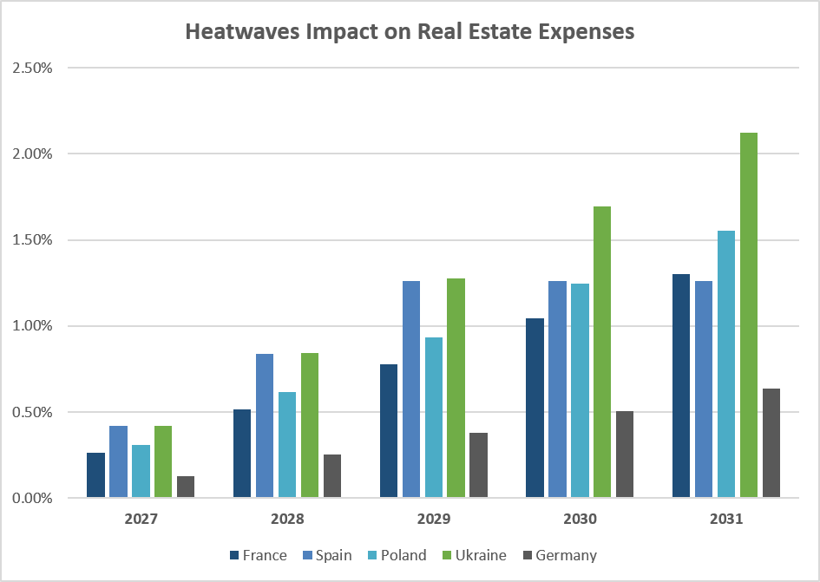
The percentages presented below represent the estimated incremental impact of heatwave conditions on operating expenses. For example, an estimated +1.26% impact means that operating expenses are estimated to be 1.26% higher under the assessed heatwave conditions, reflecting additional cooling, safety measures and labour costs.
Ukraine records the highest average increase in operating expenses among the countries analysed. Expenses increase from 0.42% in 2027 to 2.12% in 2031, resulting in an average estimated increase of approximately 1.27%. The results indicate that heatwave conditions can require progressively greater operational resources, particularly through additional cooling, safety measures and labour costs.
Spain experiences the second-highest average increase in operating expenses. Expenses increase from approximately 0.42% in 2027 to 1.26% by 2029, remaining at approximately 1.26% through 2031. The average estimated increase reaches approximately 1.01%. The results illustrate the additional operational requirements associated with extreme heat, particularly increased cooling requirements, worker-safety measures and labour costs.
Poland experiences a steady increase in operating expenses, from approximately 0.31% in 2027 to 1.56% in 2031, resulting in an average estimated increase of approximately 0.93%. The progressive cost increase suggests that heatwave conditions can create an additional operating burden for real estate operators and construction activities.
France experiences an increase in operating expenses from approximately 0.26% in 2027 to 1.30% in 2031, resulting in an average estimated increase of approximately 0.78%. The increase reflects the additional resources required to maintain safe working conditions and manage higher cooling requirements under extreme heat conditions.
Germany displays the lowest operating expense increase among the countries analysed, with expenses rising from approximately 0.13% in 2027 to 0.63% in 2031, resulting in an average estimated increase of approximately 0.38%. Despite the comparatively lower impact, the results demonstrate that heatwave conditions can still generate additional operating costs for real estate operators and construction activities.
Overall, the results indicate that heatwaves generate additional operating expenses across all five countries. Across the five-country assessment, the average estimated increase in operating expenses is approximately 0.87%.
Financial Implications
The analysis highlights an important observation.
Heatwaves can affect multiple financial variables simultaneously.
The first transmission mechanism operates through labour productivity. Extreme temperatures can make construction activities more difficult and reduce the efficiency of work performed under heatwave conditions.
The second operates through construction activity. Lower productivity can affect project execution and construction timelines, creating potential financial consequences for real estate developers and operators.
The third operates through operating expenses. Higher cooling requirements, additional safety measures and increasing labour costs create an additional financial burden under heatwave conditions.
These effects can therefore create a combined financial impact on real estate activities.
A reduction in economic activity can affect expected project output, while higher operating costs can simultaneously increase the resources required to maintain operations.
For lenders, investors, developers, insurers and asset managers, understanding these transmission mechanisms becomes increasingly important when assessing:
Investment decisions
Project profitability
Financing conditions
Asset-level resilience
Portfolio exposure
Construction timelines
Operating margins
Climate adaptation strategies
Traditional climate indicators describe environmental exposure.
Financial decisions require understanding how those hazards ultimately affect revenues, operating expenses, capital expenditure, cash flows and valuation.
The results presented in this assessment provide an estimate of the financial magnitude of heatwave-related impacts on real estate economic activity and operating expenses. They illustrate how physical climate hazards can translate into measurable financial effects across the real estate value chain.
5/ Conclusion
Heatwaves represent an increasingly relevant physical climate risk for the European real estate sector.
The comparative assessment presented in this paper demonstrates that the same physical climate hazard can generate different financial outcomes depending on regional exposure, operating conditions and sector vulnerability.
Ukraine and Spain record the highest average estimated impacts on real estate economic activity, at approximately -0.51% and -0.50%, respectively. France and Poland record average impacts of approximately -0.31% and -0.32%, while Germany records the lowest average impact at approximately -0.16%.
Operating expenses increase across all five countries. Ukraine records the highest average estimated increase at approximately 1.27%, followed by Spain at 1.01%, Poland at 0.93%, France at 0.78%, and Germany at 0.38%.
Across the five countries, the average estimated impact on real estate economic activity is approximately -0.36%, while operating expenses increase by approximately 0.87%.
Importantly, the financial impact of heatwaves extends beyond direct physical damage to buildings.
Reduced labour productivity, construction disruption, higher cooling requirements, additional safety measures and increasing labour costs can create a combined financial effect across the real estate value chain.
By translating physical climate risks into financial variables, ATLARIS enables financial institutions, investors and corporates to move beyond qualitative climate assessments and integrate environmental risks directly into financial analysis, investment decisions and strategic planning.
As climate events become more frequent and more intense, pricing environmental risk will increasingly become a prerequisite for sound financial decision-making.
Related Research Areas
Climate Risk Assessment
Environmental Financial Risk
Sustainable Finance
Physical Climate Risk
Real Estate Economics
Construction Risk
Financial Scenario Analysis
Climate Adaptation
Investment Risk
Portfolio Risk
Asset-Level Climate Risk
Operational Risk